Great Power Banks For Easy Power on The Go
Highlights
- Every pick here has a Qi2 25W record that anyone can look up.
- 10,000mAh is the standard capacity in this category, and roughly 1.5 full phone charges.
- Slim passive-cooled packs hit 25W and then step down. Sustained 25W generally needs active cooling or a thicker body.
- Big-name magnetic power banks are often Qi2 15W. The 15W and 25W versions frequently share a product family name. So check the specs and certification to be sure.
There’s Qi2, then there’s Qi2 25W
Worth pausing on, because this category is where most people get confused.
Qi2 charges at 15W. Qi2 25W charges at 25W, roughly 70% more power, and it's the tier that closes most of the gap to a cable. Both go through the same certification testing. Both carry the same magnetic alignment. The difference is the ceiling, and the price usually tracks it, with 15W packs commonly landing around $40 and 25W packs closer to $55 and up.
Which one to buy depends mostly on the phone. These are the handsets certified at Qi2 25W:
- Apple: iPhone 16, 16 Plus, 16 Pro, 16 Pro Max, iPhone 17, 17 Pro, 17 Pro Max, iPhone Air
- Samsung: Galaxy S26, S26+, S26 Ultra, S26 FE, Galaxy Z Flip8, Z Fold8, Z Fold8 Ultra
- Google: Pixel 10 Pro XL
- Motorola: edge 70 max
For everyday carry, where thinness wins.
Baseus PicoGo AM52
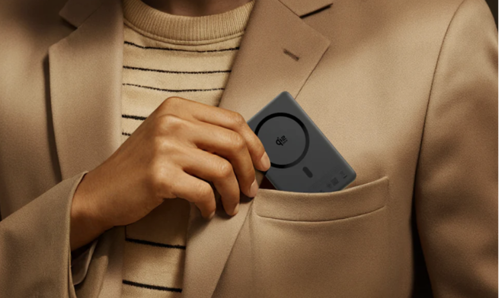
The one most reviewers reach for first. Around 16mm thick in an aluminium alloy body, which Macworld called the slimmest 25W 10,000mAh pack it had tested.
A triple cooling arrangement holds the magnetic pad closer to full speed than most passive packs manage, and it charges two devices at once. Around $60 to $80.
INIU SnapGo Air
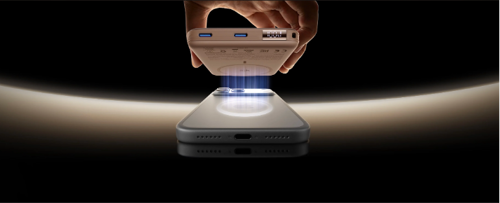
Half an inch thick, which is thin enough that the phone still feels like a phone with it attached. INIU quotes an iPhone 17 Pro at 50% in 33 minutes, and rates the magnetic grip at 13N, so it holds through a walk or a one-handed scroll rather than sliding off.
The USB-C cable is integrated into the body and detaches to work as a normal 45W charging cable, which removes the usual problem of needing a second cable to recharge the pack itself. There's a digital display for the charge level, a second magnet on the outward face for a wallet or a grip, and a three-year warranty.
KUXIU S4
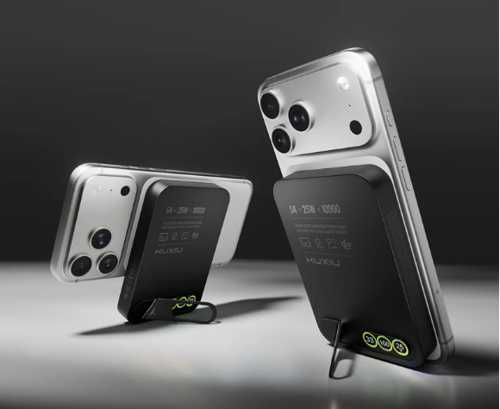
The technically interesting one. KUXIU builds the S4 around a semi-solid-state cell rather than a conventional lithium-ion pouch, a chemistry chosen for thermal stability, and claims 13.7mm, which would make it the thinnest 10,000mAh pack in the category.
The aluminium alloy shell does double duty as a heat sink. Its TFT (Thin-Film Transistor) display goes further than the usual percentage readout, reporting battery health, cell temperature, remaining capacity, and live charging wattage, so you can watch the pack step down under load rather than guess at it. A foldable stand on the back props the phone up while it charges.
For sustained speed rather than a fast start.
Sharge ICEMAG 3
The only pack here with a real cooling fan, which is the whole argument for it. Passive packs reach 25W and then taper as heat builds; this one keeps moving air and holds the speed closer to flat across a full top-up. The shell is transparent with RGB lighting underneath, which will either appeal or won't. A foldable kickstand, 35W wired over a built-in cable, and a capacity that stays within airline limits.
UGREEN MagFlow 10,000mAh
One of the first power banks to certify at Qi2 25W. Seventeen magnets in the alignment ring, which is more than most and shows in how firmly it locks on. The braided USB-C cable doubles as the carry strap, a second USB-C port runs at 30W, and it can supply three devices at once. A display on the front shows the charge level. Around $90.
For a phone you also want to prop up.
Belkin UltraCharge Pro 10K Power Bank
Built around a kickstand, which sounds minor until you've watched something on a plane tray table without one. The stand folds out of the back and holds the phone at a usable angle while charging, and there's a digital display alongside it. 30W wired over USB-C. Belkin rates the capacity as TSA carry-on compliant, and the build quality is what you'd expect at $99, which is the top of this list.
What separates them
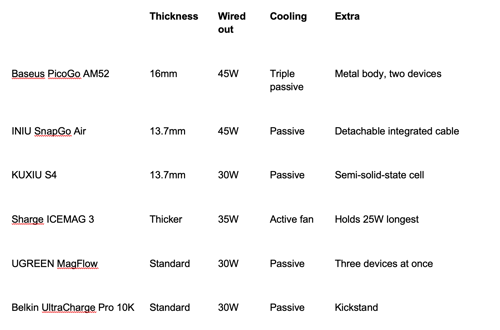
All six are 10,000mAh.
A few questions that come up
Will a 25W pack charge my phone at 25W? Only if the phone supports the tier. iPhone 17 does natively, iPhone 16 does on iOS 26, Pixel 10 Pro XL does, and Galaxy S26 Ultra does with a magnetic case. Everything else charges at its own ceiling, which is still perfectly fast.
Why does the speed drop after a few minutes? Heat. A slim passive pack sheds it slowly, so it steps down to protect the cells and your battery. That behavior is the system working correctly.
Is a 15W pack a mistake? No. It's a less expensive product with a lower ceiling, certified to the same standard and using the same magnetic alignment. On a phone that can't take 25W, it charges at exactly the same speed as the more expensive 25W power bank.
Can I fly with one? A 10,000mAh pack sits well under the usual airline limit, but rules on using them during a flight have been tightening, so check your carrier before you travel.
Does a case get in the way? A thin magnetic case is fine. For best performance, look for cases no more than 2mm thick and with magnets. Thicker cases widen the gap between the coils and cost you speed. A case with no magnets breaks the alignment that 25W depends on.